
make it a habit
Advent as a foundation for family worship

This year, some of us will once again be shocked to find that, though we mean to do it every year, we just can’t manage to catch the habit of doing our Advent readings and lighting the candles and singing the hymns—having spent the preceding eleven months bustling about life with nary a thought for family worship, Scripture reading, catechism, hymn singing, etc. If the four weeks leading up to Christmas are the only time you think about family worship, I’ve got news for you: it’s never going to take.
However, with Advent being the beginning of the church year, this is a wonderful jumping-off point for a regular practice of family worship. Getting started in December sets your new habit apart from all the others you’ll likely embark upon in January. Don’t let your devotional life be just another resolution; intentional spiritual development is a pattern of life that determines the nature and direction of all other resolutions.
Use the readings, hymns, and prayers that your church supplies, or if your church is sadly one of those in dire liturgical poverty, try one of the resources in this post. Once you’ve got a plan in place for the next four weeks, set a daily alarm on your phone. Make a plan for nights that the kids have sports or you have an event. And because you want this habit to become lifelong, ask your pastor now to help you make a plan for family worship that you can continue after the Advent season is over.
Little-known fact: not long ago, a man could come under church discipline for failing to lead his family in regular Scripture reading and prayer at home. We are not in the business of populating hell. Hear the conviction of the London Baptist Confession (1689):
And verily there is one spring and cause of the decay of religion in our day which we cannot but touch upon and earnestly urge a redress of, and that is the neglect of the worship of God in families by those to whom the charge and conduct of them is committed. May not the gross ignorance and instability of many, with the profaneness of others, be justly charged upon their parents and masters, who have not trained them up in the way wherein they ought to walk when they were young, but have neglected those frequent and solemn commands which the Lord hath laid upon them, so to catechise and instruct them that their tender years might be seasoned with the knowledge of the truth of God as revealed in the Scriptures; and also by their own omission of prayer and other duties of religion of their families, together with the ill example of their loose conversation, having, inured them first to a neglect and the contempt of all piety and religion? We know this will not excuse the blindness and wickedness of any, but certainly it will fall heavy upon those that have been thus the occasion thereof; they indeed die in their sins, but will not their blood be required of those under whose care they were, who yet permitted them to go on without warning — yea, led them into the paths of destruction? And will not the diligence of Christians with respect to the discharge of these duties in ages past rise up in judgment against and condemn many of those who would be esteemed such now?
My fiancé and I are both regular Bible readers and prayers, but have recently started forming a plan to institute family worship—including catechism and hymn singing—with just the two of us before we have kids, so that when we do have kids, we’ll already have a routine in place. Babies throw everything out of whack, so there’s no sense in waiting until we have a little bundle of chaos to try and start a new routine. If you do find yourself in that place of chaos, though, don’t lose heart. Ask God for help and be diligent! He will not despise your attempts to worship faithfully as a family.
helps for Advent devotions and family worship
for singing
First, I highly recommend investing in a hymnal. If we’re going to build a flourishing Christian culture, we need to know and love the songs of our people. Psalm and hymn singing is not only a command (Colossians 3:16) but also a pillar of strength for God's people in times of adversity—think of the choral vanguard of Jehoshaphat (2 Chronicles 20); think of Sts. Paul and Silas’s singing in prison (Acts 16); think of the Christians at Geneva singing the Psalter while under attack. In the season of Advent, only music can fully express our longing for His coming and our joy in His dwelling among us.
Two hymnals I have used long enough to be able to recommend:
An archivist at heart, I’ve been collecting some hymns that are largely lost to the current evangelical tradition. You can find a few of these in the hymnals above, but in the process of researching ancient to early modern hymns, I’ve put together a bundle of my favorites, which you can download for free.
For family worship, choose one hymn per week and sing together before or after the Scripture reading. At Advent, this is fun and easy because everyone loves Christmas carols. The trick is to keep it going throughout the year. Pick some hymns you already know and love, and then mix in a new one every now and then. If you can’t decide on one, check the date and pick a hymn or psalm of the corresponding number. Today is 12/1, so I would pick #121 in the hymnal or Psalm 121.
With older kids, try to sing every verse—you’ll gain a rich reward of theological insight this way—but younger kids might only have the attention span for a verse or two. Despise not the day of small beginnings: doing this consistently over time means learning 52 hymns in a year. Theoretically, you’d cover nearly the entire hymnal in a decade, which is roughly the amount of time you have as a parent (there are about ten years between literacy acquisition and high school graduation).
for reading
Dr. Uri Brito has started an Advent series over on his Substack, The Perspectivalist. These are meditations to treasure, and to still your mind and heart as you approach the Advent readings.
Another great resource that my pastor shared with my congregation is a quick read, For Signs and Seasons by Duane Garner.
I reviewed this wonderful little book several months ago in this post.
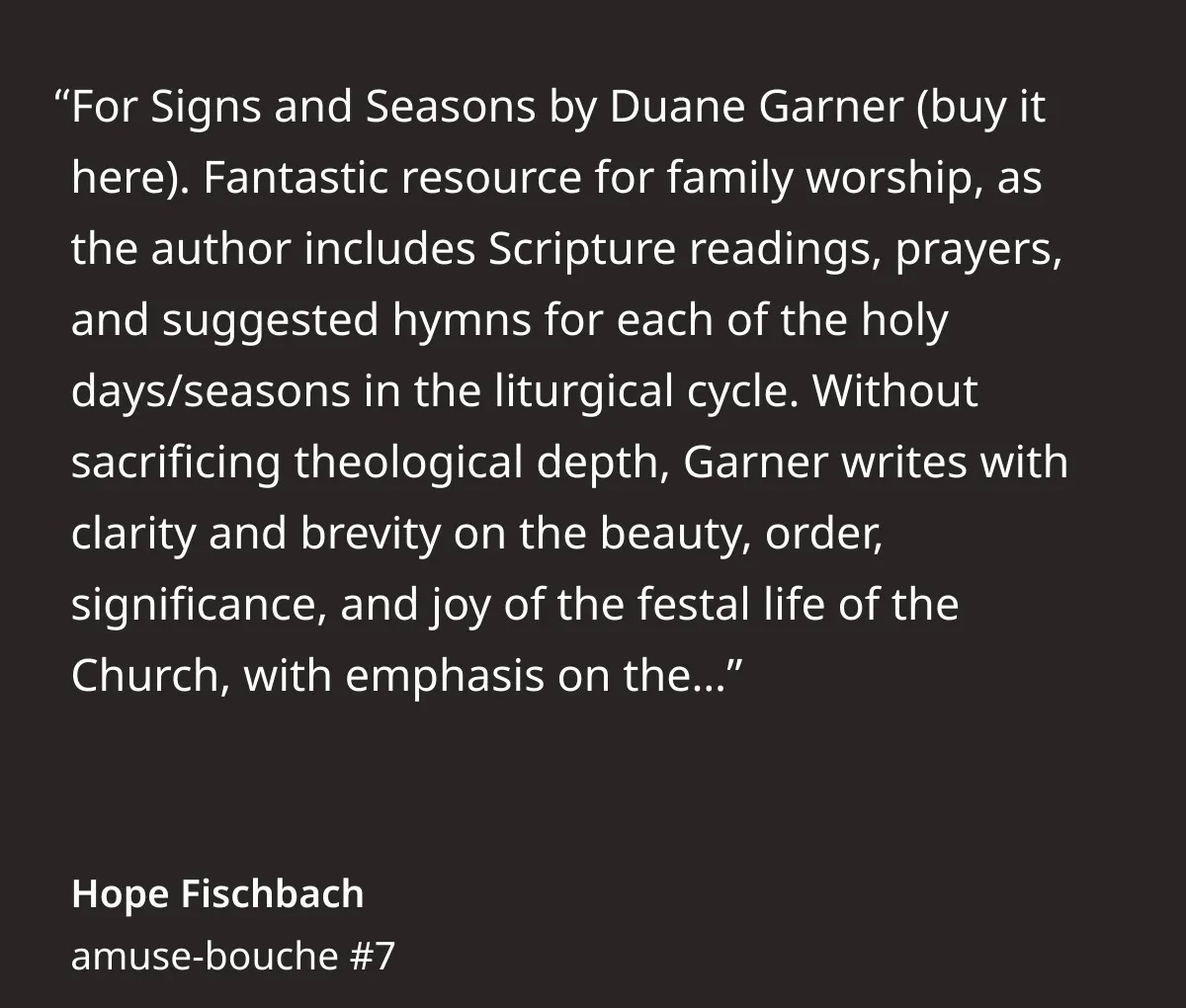
While not a complete Advent guide (I’m still on the hunt for an Advent guide I really like… I’ve gone through a few), FSAS gives some great pointers that you can keep simple or expand and adorn as you grow in understanding and spiritual depth.
Bonus: it’ll help you stick to your family worship commitment long after Advent, since it covers the major events of the entire liturgical year.
for catechism
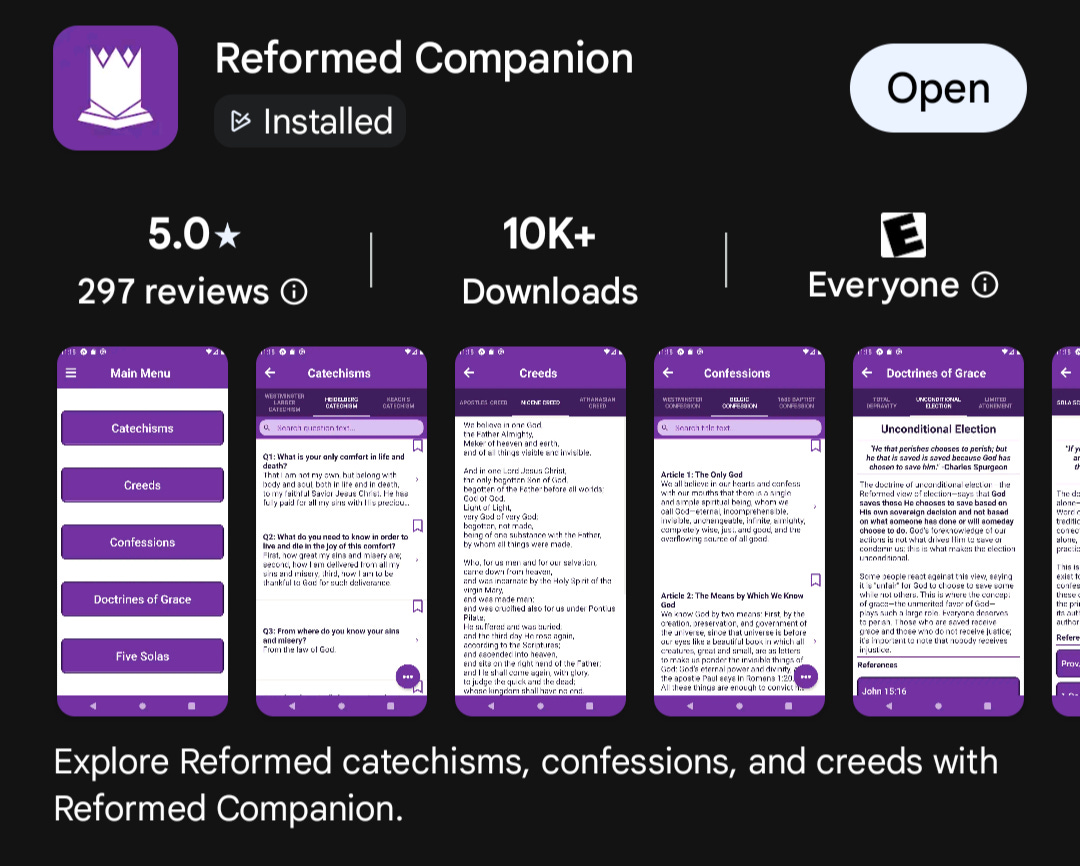
This app is fantastic. Available for both iPhone and Android, it contains:
the Heidelberg, Keach’s, and Westminster Shorter and Larger Catechisms;
the Westminster, Belgic, 1689 Baptist, and Second Helvetic Confessions, as well as the Canons of Dort and the Thirty-Nine Articles;
the Nicene, Apostles, Athanasian, and Chalcedonian Creeds;
the Doctrines of Grace (TULIP);
and the Five Solas.
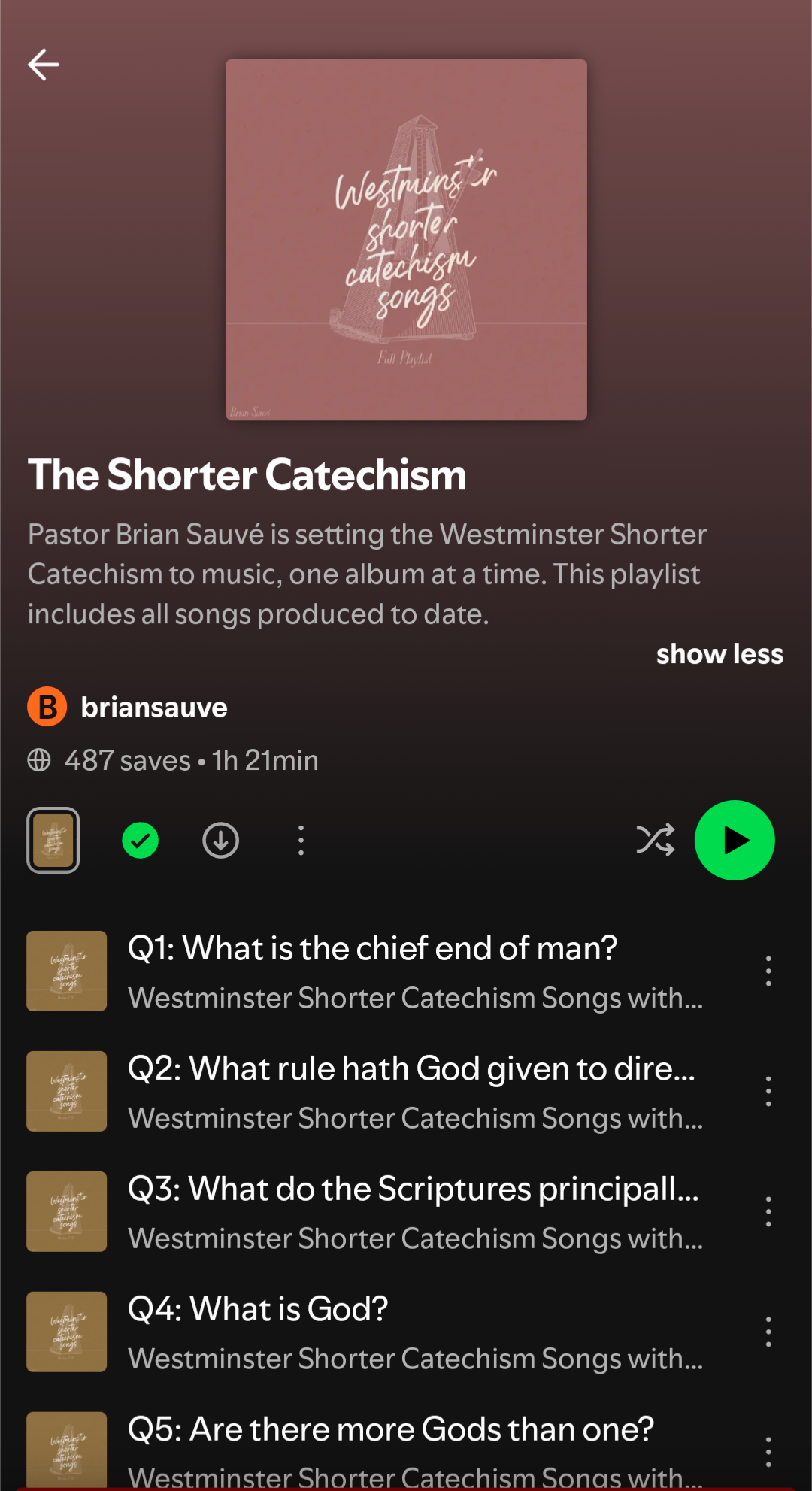
While Reformed Companion is an amazing help, I struggle to memorize anything without the aid of a rhyme or tune. But I’ve nailed down the first seven questions within a week just by listening to the Westminster Shorter Catechism songs by Brian Sauvé! I also love Brian’s Psalm settings—check those out here.
Canon+ To the Word challenge (and audio)
My typical morning routine goes like this:
Wake up and listen to the Scripture passages of the day with the To the Word Bible reading challenge on the Canon+ app (you can also access this plan on the YouVersion Bible app—I have both) while getting ready and making coffee.
Put the catechism songs on in the car while driving to work.
Listen to some sort of audiobook or podcast on the way home from work and while tidying up at home, aiming for a mix of classic fiction, historical, theological, or Christian living content.


I usually have my prayer time in the evening before I go to bed, as I’ve shared in this post, which includes resources I use and recommend for cultivating a practice of prayer. I always intend to read Scripture before bed, as well, but most of the time I get carried away talking to the Lord until I fall asleep. I do the formal, pre-written prayers first, and after that, have more of an informal chat with the Lord about whatever is on my mind. For the formal part, which I think is an important discipline, try to stick to a structure that follows the covenant renewal pattern that Jeffrey J. Meyers exposits in his excellent volume, The Lord’s Service:
Call to worship
Confession
Consecration
Communion
Commissioning
In keeping your word, I talked about some prayers that might be good to memorize. Since then, I’ve been learning more about the structure and pattern of biblical worship and am trying to incorporate my new knowledge into my prayer life. Because I’m still in the process of building up the store of prayers I know by heart, that pattern looks for me like this:
Start off with the Gloria Patri
O Heavenly King
Psalm 51, or parts of it, or just regular ol’ personal confession. Sometimes I get out my church bulletin from the week’s service and use the prayer of confession printed therein.
Our Father
Doxology
Think through the events of the day and thank God for all the gifts I enjoyed that day.
Go through my list of things to pray about/people to pray for (supplication).
Give “thanks in advance” for answered prayers.
Ask for help to discern and obey God’s will in my daily life.
Chat about random stuff that bubbles up to the surface. Sometimes I won’t realize it as a prayer request during “supplication time,” but I’ll suddenly notice a nagging thought or worry lingering in my mind as I’m going to sleep, so I just narrate those thoughts to God and ask Him what He thinks.
Some people might recognize the ACTS pattern (Adoration, Confession, Thanksgiving, Supplication). That one is also good. The important thing, I’ve learned from Meyers, is to make sure that confession happens early. We don’t get to come before God the same way we waltz into a coffee shop meetup with our friends.
“To seek an entrance with God Almighty without humbly confessing sin and faithfully receiving His forgiveness in Christ is sub-Christian at best” (Meyers, 181).
I’m often reminded of this in the Trisagion prayer, “Holy God, Holy Mighty, Holy Immortal, have mercy on us.” He is merciful and our Friend, but not only that.
Also, the posture of prayer is important. We can see this all throughout Scripture, but we often aren’t paying attention. In The Lord’s Service, Meyers documents with great scholarship a long list of biblical references showing clearly that this is so, references that we in Protestant World tend to overlook.
Those of us raised in evangelicalism are probably inappropriately comfy in our “coffee and Jesus” routine. I have had to make some adjustments in my own faith practices over the last few years, having come to the conviction that meaning well and doing well are two different things, and although God is great in mercy, He doesn’t necessarily smile on the former when He has given clear instructions about the latter.
So, like most people, I still usually make a cup of tea or coffee to drink while I’m having my prayer time, but I have started being more careful about my approach. Based on what I’ve learned from Meyers, God clearly loves to eat and drink with His people, and while that’s most pointedly expressed in the Eucharist, it also more or less follows that we can have a cup of coffee with God and that He would enjoy spending that time with us. But I try to reserve that table fellowship for after I’ve had the time of confession and adoration, where God’s holiness and my sinfulness are being acknowledged.
What does this actually look like for me? (Let me emphasize that I’m just a laywoman sharing from my experience in a way that I hope resembles Titus 2-type behavior.)
During my formal prayers (Gloria Patri through supplication), I stand or kneel, as I would do in church during the liturgy.
After my last thanksgiving and “commissioning” prayer, I sit down on the sofa or get into bed, knowing that my sins are forgiven and that I have not sinned against anyone by failing to pray for them (1 Samuel 12:23), so I’m in a state of joyful communion with God.
This is when I “remember thee upon my bed, and meditate on thee in the night watches” (Psalm 63:6). At this point I’m just chatting with God, enjoying fellowship with Him, and having a cup of tea with Him before bed.
Standing before the Judge of all the earth asking for forgiveness of sin isn’t exactly the time for a casual sip. It feels very uncomfortable for me to do the “confession” part of my prayer while lounging on the couch and drinking Sleepytime, and I truly think the reason for that discomfort is the biblical reality that posture matters.
But, the Bible also says to pray without ceasing, and the psalmist says he prays on his bed at night, so there’s obviously a time and a place for just simply spending time with God and enjoying His friendship. Meyers states that communion absolutely cannot come before confession and consecration, but the whole point of confession and consecration is communion, aka fellowship, friendship, oneness. We often get mixed up about this and somehow think and behave as though holiness were a perpetual state of gloomy introspection and self-flagellation. Not so! Of course we need to acknowledge our sin with humility and sincere sorrow; but, He is faithful and just to forgive and cleanse us of unrighteousness, so that means we can go from repentance right back to rejoicing.
I’m not very good about having a prayer time in the morning other than saying “Thank You, God, for another day!” when I first wake up. When I get to the end of my Bible listening, I usually pray for help to put what I heard into action. Certainly, I need to do better. But I am happy to say that these days I am praying more throughout the day than I used to, and am more likely to pause for a quick prayer when something comes to mind, rather than “saving it up” for my evening prayers.
worship and watchfulness
The first of the Advent readings warn and encourage: Wake up! Christ will soon appear! Don’t be found sleeping at your post!
Make Advent a time of preparation and formation, both for Christmas and for the year ahead, bearing always in mind the Second Advent—
because He comes, He surely comes
The Judge of earth to be
With justice He will judge the world
All men with equity
Let us keep our lamps lit to meet Him when He comes by doing the good and faithful work of regular worship and watchfulness.
Be blessed in obedience!
I'm sure you've heard of Waiting on the Word by Malcom Guite as an Advent Devotional! It's becoming one of my traditions for this pentinential season. Also Daily Office doesn't need to be only for Anglicans ;) Love that you have a Trinity Hymnal.
A lot of good resources here! My husband and I have enjoyed the Advent devotional O Come, O Come Emmanuel by Jonathan Gibson - it's very liturgical, it and features a good bit from the Reformed confessions/catechisms, so it might be worth checking out.